Please feel free to call or e-mail mccfixit@hotmail.com with ideas for articles you would like us to write about.

By Matt Raker
Low brake fluid is an indicator that shouldn't be ignored.

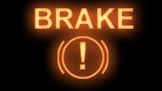
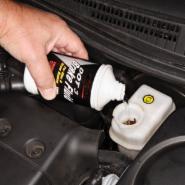
        So your driving along and that red brake warning light starts flickering sporadically when turning corners and going over bumps.  You then check your emergency brake to see if it is partially set and all seems fine, the brakes are working perfectly.  So now what?  Check the owner's manual to see what the light means?  Stop by your favorite shop and have it checked out?  The truth is, both are correct.  The red brake light can mean different things, but a flickering brake light usually indicates low brake fluid.  Now you've established the brake fluid level is below the minimum line on the reservoir.  So what now?  Just top it off and be on your merry way, right?  This is good practice in a unhandy situation to get you home, but topping off the fluid did not fix the real problem.  Once again, your car is trying to tell you something.  There are only two ways the brake fluid level drops in the reservoir.  A) A leak in the brake system hydraulics.  B) Brake pad or brake shoe lining is worn below spec.  Brake fluid reservoir capacity is sized according to the amount of fluid your brake system displaces to fill the brake calipers, lines and brake cylinders.  As brakes wear down, the caliper pistons extend outward to keep the brake pads close to the rotor.  When new pads are installed these pistons are compressed back into the calipers forcing the fluid back into the reservoir.  Your brake fluid reservoir makes for a handy gauge to determine when your brakes need replacing.  If the fluid is topped off regularly, that purpose of the red brake warning light is defeated and brakes will have to be inspected regularly.  Or worse, wait until you hear that nasty grinding noise that always seems to happen at the most inopportune time.  


By Matt Raker
Why to avoid part store diagnostics.
        These days we are trying save money any way we can.  People often turn to alternative resources when it comes to diagnosing that pesky check engine light.  Many part store chains 
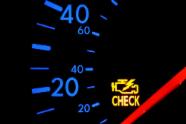
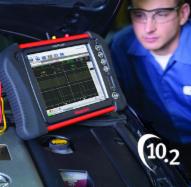
are now offering "free code scans" in an effort to drive more traffic to there stores.  We have had many customers come into our shop with a part-in-hand saying that Autoz**e said or Adv**ce Auto said I need this part replaced because the "code" said so.  They ask us to skip the diagnostics because that costs money and simply replace the part.  Sometimes it's hard not to laugh.  But we have decided laughing at the front counter in front of a customer regarding their request is mean and bad for business.  So, instead we took the time to write this article about the pro's and con's of part store diagnostics.  Here is a typical example: Jim is on his way to work.  His route includes driving up a hill where he notices the car doesn't have the power it is used to.  Seems strange he thinks to himself, must have gotten some bad fuel.  Upon traveling home his route includes traveling up another hill being that this is the same route his grandfather used to walk to school.  Again he notices the car just doesn't have the power it used to.  Seconds later the "CHECK ENGINE" light illuminates.  Earlier in the trip he heard a radio ad for a certain part store offering "free check engine light scans", it was like music to Jim's ears.  He decides to stop into this part store to take them up on their offer.  The store manager is happily willing to help.  He grabs his prized $60 Actron code reader and plugs it in to Jim's 04' Chevy Impala.  It returns 2 codes: P0131 & P0171- B1S1 Low Voltage (the BANK 1 O2 sensor voltage stayed low for too long & system lean).  The store manager informs him of the five things that can set this code but is likely the O2 sensor.  Jim thinks to himself, paying a shop for diagnostics is expensive so I'll take a gamble and buy the $70.00 part and replace it myself.  Not surprisingly the next day the car runs the same and the light is back on.  Jim decides to go see if he can return the part because it didn't change anything.  The store manager sadly informs him "electronic parts cannot be returned once installed".  Jim is known for being a logical person and isn't known for repeating mistakes.  He remembers taking his car to a shop and it was like 600 bucks to fix it.  Jim decides to get quotes for all the possible parts associated with this code. The store manager writes him a estimate for the following: Mass Air Flow Sensor -$172.99, Fuel Pump Module-$429.98, Fuel Filter-$20.99, O2 Sensor - already purchased, totaling an additional $623.97.  He brought the car home and began installing one part at a time starting with the easiest.  Mass airflow sensor = no change, then the fuel filter = no change (except it was old and probably needed it anyway).  He took the fuel pump module out of the box.  At this point he became intimidated with the fuel pump because it was located in the fuel tank.  Determined not to take it to a shop because they are just too expensive, one shop wanted $130 just to change the pump, he then checks out craigslist to see if he can find a good mechanic that will do it for less.  He spots an ad in the services link, "Experienced mechanic, will work cheap, will come to you.  $30 an hour.  Jackpot!  He thinks to himself.  He calls the phone number listed in the ad and the mechanic was there in about twenty minutes with tool box in hand.  He was excited to start the work and immediately began the process of removing the fuel tank.  Although the job became a little complicated attempting to remove a 3/4 full fuel tank using nothing but jack stands and a floor creeper.  Eight hours later the car was up and running.  The mechanic was proud of the job well done and handed Jim the handwritten $190 bill.  Jim was confused about the bill remembering the quote for $130 for the 1.6 hours labor from a certified shop.  The mechanic then went on to justify the inflated bill by stating that he has a lesser shop rate but it takes longer to come on site and work on the floor.  He also stated that he deducted the time he had to go to the part store to get more hose clamps.  Jim and the mechanic argued a bit before eventually paying the bill and the mechanic went on his way.  Jim immediately jumped in the car and took it for a test drive.  The car didn't seem to run any different but wasn't that bad either.  Next day on his way to work the check engine light illuminated again.  By this time Jim was ready to set his car on fire and collect the insurance.  Jim decided to bite the bullet and bring his car to a professional.  He decided to go with the referral he got from the part store he got the parts from.  He arrived at his appointment a little mad about having to pay a minimum $40 to diagnose the car. The diagnostic tech plugged the $10,000 Snap-on Verus into Jim's Impala, pulled a code P0131 & P0171 from the vehicle and proceeded to do a road test and data scan. The tech noticed that under moderate acceleration, the fuel trims were going positive by 25% at times (compensating for lean condition, not enough fuel) and was causing the O2 sensor voltage to drop low.  An experienced tech knows when you have a lean condition or low O2 voltage, first check for vacuum leaks, if that checks out, move on to the next and so-on.  The tech probed around the engine bay checking all gaskets and hoses for leaks.  In the process the tech noticed a small split on the underside of the intake duct between the mass airflow sensor and the throttle body.  This would allow non-metered air to enter the engine and cause the system to go lean. The fix: Air intake duct $75, Labor w/diagnostics $59 total: $134.  The moral: Efforts to save time and money often cost more time and money.  Trouble codes will not tell you there is a bad part, they will only indicate what part is being affected.  Codes are meant to give direction and is only step one in diagnostic flow.


Actron code reader


Snap-On Verus Diagnostic Platform